
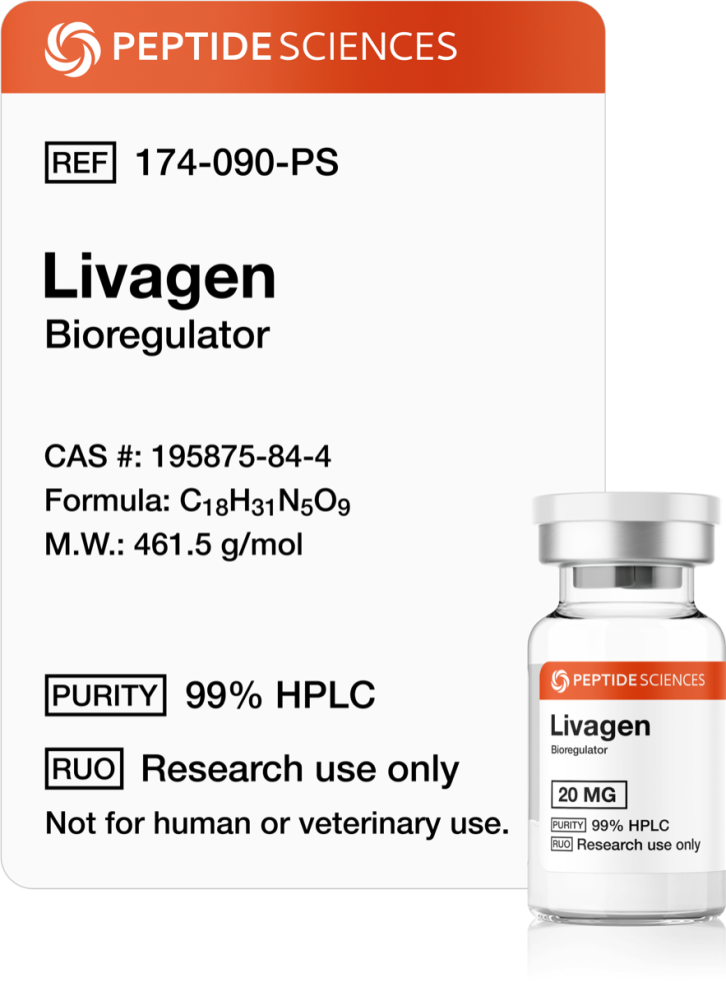
Livagen 20mg (Bioregulator)
$65.00
Livagen is a short bioregulatory peptide that has direct effects on DNA structure and function. It is best known for its ability to decondense chromatin, thereby increasing the expression of certain genes and improving the “youthful” profile of cells. Its most studied effects are on lymphocytes of the immune system. Through these cells, Livagen has been shown to activate the immune system and offset disease in the heart, GI tract, immune system, and central nervous system. Livagen research has also shown promise in the area of nociception and pain control. Ongoing research will help to further unravel the promise of Livagen and bring humanity closer to understanding the processes of aging and senescence.
Livagen
Livagen, a short peptide closely related to Epitalon (aka Epithalon), is known for its effects on the immune system, GI tract, and liver. As a peptide bioregulator, Livagen has direct effects on DNA and gene expression patterns. Its purported anti-aging properties are thought to result from Livagen’s ability to activate genes in the GI tract and immune system that are otherwise silenced as a result of DNA condensation with age.
Livagen Structure
Amino Acid Sequence: Lys-Glu-Asp-Ala
Molecular Formula: C18H31N5O9
Molecular Weight: 461.5 g/mol
PubChem CID: 87919683
CAS No: 195875-84-4 (Deprecated: 402856-42-2)Alternative Names: SCHEMBL5967826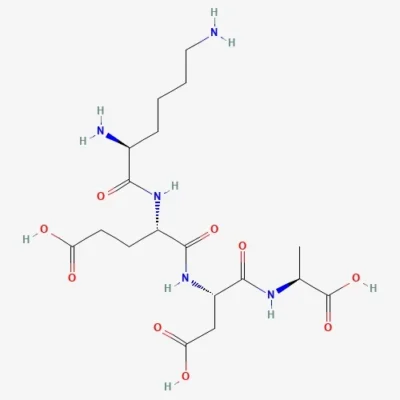
As a low-molecular-weight, charged peptide, Livagen is typically studied for interactions that may influence macromolecular assemblies (e.g., nucleoprotein complexes) and enzyme systems measurable via biochemical assays.
In research workflows, sequence-confirmed material enables controlled investigation of sequence-dependent effects on chromatin accessibility, transcriptional output, and enzyme activity readouts under defined experimental conditions.
Research Applications
Livagen has been used in research programs investigating peptide-regulated genome function, particularly:
Chromatin state modulation in lymphocyte-enriched cell populations (e.g., quantifying condensation/decondensation phenotypes and transcriptional accessibility)
Gene expression shifts associated with nucleolar activity and ribosomal gene transcription (e.g., rRNA biogenesis markers, protein synthesis capacity proxies)
Cellular functional outputs downstream of altered chromatin accessibility (e.g., cytokine transcription profiles in immune cells, proliferation indices, and stress-response transcriptional programs in vitro)
Enzyme activity assays relevant to peptide metabolism and degradation pathways in biological matrices (e.g., peptidase activity measurements)
Neuroimmune and gastrointestinal signaling research in animal models where endogenous opioid peptide systems and mucosal protection pathways are assessed via receptor pharmacology, mediator quantification (e.g., nitric oxide and prostaglandin signaling), and barrier function endpoints
Pathway / Mechanistic Context
In eukaryotic cells, genomic DNA is organized through hierarchical compaction, progressing from nucleosomes (DNA wrapped around histone proteins) to higher-order chromatin domains and ultimately condensed chromosomes during mitosis. This structural organization is not only a packaging solution; it is also a central regulatory layer controlling which genomic regions remain accessible to transcription factors, polymerases, and chromatin-associated enzymatic machinery[1].
Chromatin condensation state (euchromatin vs. heterochromatin) influences transcriptional permissiveness. Decondensation events can increase accessibility of specific loci, enabling transcriptional activation of gene sets that may be otherwise repressed under baseline conditions. In experimental systems, chromatin accessibility can be monitored using cytological approaches (e.g., heterochromatin markers, NOR activity, acrocentric association readouts) and molecular assays (e.g., transcriptional profiling, rRNA synthesis markers, and chromatin accessibility methods).
Livagen has been described as influencing chromatin organization in lymphocyte preparations by promoting decondensation-associated readouts and shifting transcriptional activity patterns, including activation of loci linked to ribosomal biogenesis and synthetic capacity in certain experimental contexts[2]. Mechanistically, such observations are commonly interpreted as a change in nucleoprotein packaging that increases functional access to previously constrained genomic regions, thereby altering gene expression programs at a systems level.
Preclinical Research Summary
Published studies in the peptide bioregulator field report that short peptides, including Livagen and related sequences, can induce experimental markers consistent with chromatin “reactivation,” including shifts in condensation status and changes in transcriptional activity in lymphocyte-enriched systems[3]. In this literature, reported endpoints include chromatin decondensation phenotypes, altered gene expression patterns, and indices of increased nucleolar/ribosomal gene activity[2], [3].
Lymphocytes comprise multiple immune cell subsets (including B- and T-lineage populations) and are frequently used as model systems to study transcriptional control, cytokine signaling programs, and immunogenetic regulation under defined stimulation conditions[4]. Accordingly, chromatin accessibility shifts in these cells may be studied as upstream regulators of immune-relevant transcriptional circuits (e.g., stimulus-induced transcription, mediator production, and proliferation programs), without implying any diagnostic or therapeutic intent.
Genome Regulation Readouts in Cardiovascular-Related Research
Separate preclinical and translational research programs have examined chromatin organization and genomic instability markers in contexts associated with cardiovascular biology,
including studies that evaluate heterochromatin state, NOR activity, and acrocentric chromosome associations in lymphocyte-based assays as experimental readouts[5], [6], [7], [8].
Within these experimental frameworks, peptide-driven modulation of chromatin accessibility is treated as a variable that may influence transcriptional programs and cellular phenotypes measurable in vitro.
Peptidase Modulation and Endogenous Opioid Peptide Signaling (Preclinical Context)
Endogenous opioid peptides (e.g., enkephalins) are regulated by enzymatic degradation pathways. In biochemical research, modulation of enkephalin-degrading enzyme activity provides a mechanistic handle to study how changes in peptide turnover can shift receptor-ligand availability and downstream signaling dynamics in controlled systems[9].
Preclinical pharmacology literature further supports a role for μ- and δ-opioid receptor signaling in experimental models of gastric mucosal protection in rodents, with downstream mediator changes (including nitric oxide and prostaglandin signaling) commonly quantified as mechanistic endpoints[10]. These findings are used to design laboratory experiments probing receptor-mediated signaling, mediator production, and barrier biology in animal models and ex vivo tissues.
Chromatin State, Genome Stability, and Cellular Aging Models
Chromatin remodeling and genome stability are frequently studied in cellular aging paradigms using cytogenetic markers (e.g., chromosomal aberrations, heterochromatin organization, and DNA repair-associated readouts) and transcriptional profiling[11]. Within this mechanistic space, peptide-driven chromatin decondensation has been discussed as a tool to interrogate relationships between higher-order genome packaging, transcriptional accessibility, and cellular functional outputs in model systems[12].
Livagen Summary
Livagen (Lys-Glu-Asp-Ala) is a short peptide used in research settings to investigate peptide-mediated regulation of genome function, with a primary emphasis on chromatin accessibility,
transcriptional activation patterns, and downstream cellular phenotypes in lymphocyte-enriched preparations and other preclinical models. Additional published work has explored enzyme activity modulation relevant to endogenous peptide
turnover and mechanistic links to receptor-mediated signaling in animal-model gastrointestinal protection paradigms.
Form & Analytical Testing
Livagen is supplied for laboratory research workflows where lot-to-lot consistency and analytical verification are required for reproducible experimental design.
Standard analytical characterization for peptide identity and composition may include chromatographic and mass-based methods
(e.g., HPLC-based purity assessment and mass spectrometric confirmation of molecular mass) as applicable to the specific batch documentation provided with the material.
Researchers commonly incorporate incoming quality checks (e.g., appearance inspection, reconstitution behavior under laboratory conditions,
and analytical confirmation against expected sequence/mass) prior to use in assays involving chromatin accessibility, gene expression profiling, enzyme activity measurements, receptor signaling studies,
and animal-model endpoints.
Article Author
The above literature was researched, edited and organized by Dr. E. Logan, M.D. Dr. E. Logan holds a doctorate degree from Case Western Reserve University School of Medicine and a B.S. in molecular biology.
Only logged in customers who have purchased this product may leave a review.
Related products
Bioregulators
Bioregulators
Bioregulators
Bioregulators
Bioregulators
Bioregulators
Bioregulators
Bioregulators
Reviews
There are no reviews yet.